How a Digital Tailoring Business Actually Works
Not a general idea of “going digital”, but the real, step-by-step way a modern tailoring shop runs its day, from the first enquiry to the final invoice, using an app instead of paper.
“Digital tailoring business” sounds like a big phrase, but in practice it is not complicated. It does not mean robots stitching clothes or customers designing garments on a screen. It means something much simpler: the same tailoring shop you already run, with its records kept on a phone instead of on paper.
The stitching, the fitting, the fabric, and the craftsmanship stay exactly the same. What changes is everything around the stitching: how a customer’s details are captured, how measurements are stored, how an order moves from booking to delivery, and how payments and invoices are tracked. This article walks through that whole process, stage by stage, the way it actually runs in a working shop.
What “Digital Tailoring Business” Actually Means
It helps to be precise about what does and does not change. A digital tailoring business is not a different kind of business; it is the same tailoring shop, run with different tools for information and record-keeping.
- What stays the same: the craft, the customer relationships, the fabric sourcing, the stitching, and the fittings.
- What changes: where and how information about customers, measurements, orders, and payments is stored, found, and shared inside the shop.
In other words, going digital is a change in the shop’s record-keeping, not in its craft. That distinction matters, because it means the switch is far less disruptive than it sounds. You are not learning a new trade. You are learning a new way to write down what you already know.
The Five Stages of a Digital Tailoring Business
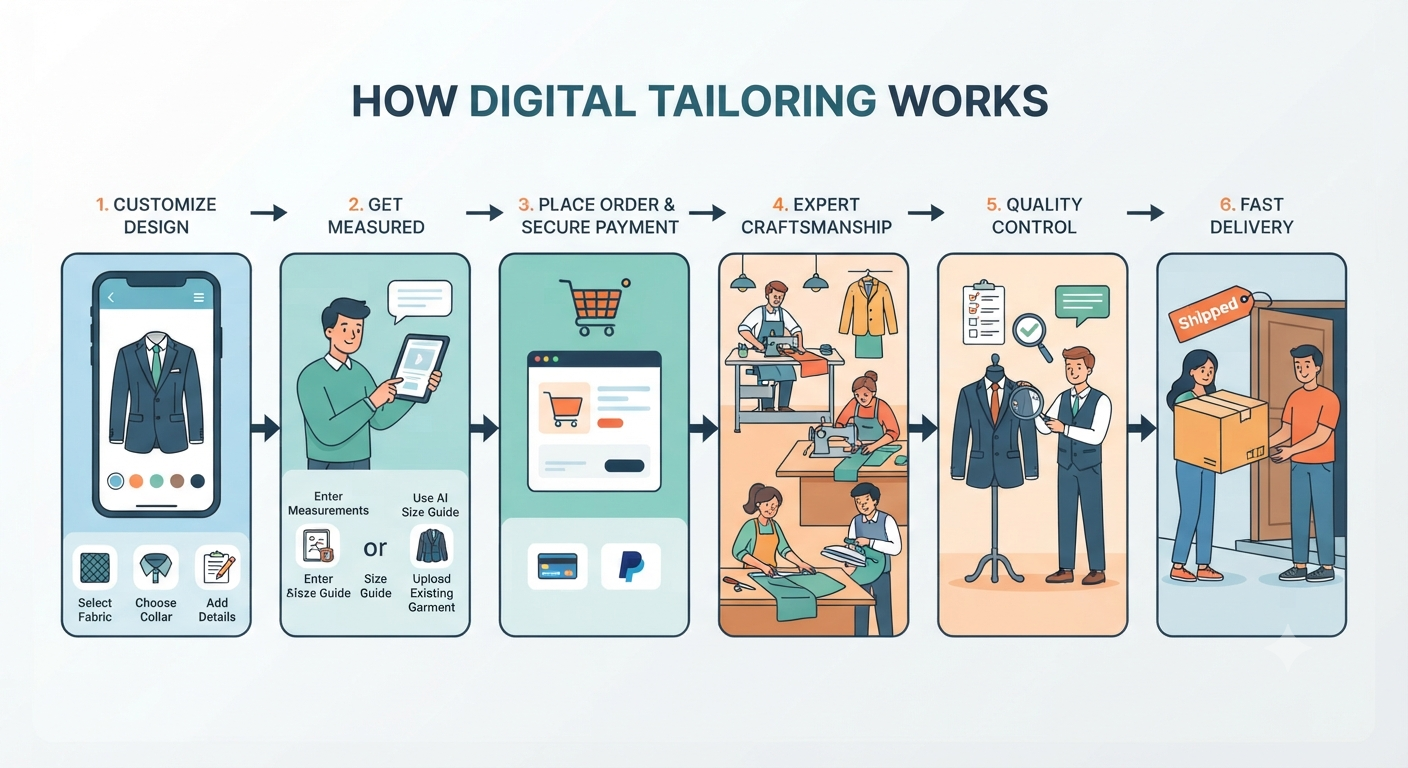
Every order that comes into a tailoring shop, digital or not, passes through the same five stages. What differs is how each stage is recorded and how easily that record can be found again later.
Stage 1: Enquiry
A customer contacts the shop, in person, by phone, or on WhatsApp. In a digital tailoring business, this is the moment a customer profile is created or opened. If the customer is new, their name and phone number are added once. If they are a returning customer, a quick search brings up their entire history immediately, so the conversation can pick up where it left off.
Stage 2: Measure and Save
Measurements are taken exactly as they always have been, by hand, with a measuring tape, by an experienced tailor. The difference is where those numbers go. Instead of a line in a notebook, they are entered into the customer’s digital profile, under the specific garment type, whether that is a blouse, kurta, salwar, sherwani, or lehenga. Once saved, that measurement set does not need to be taken again for a repeat order of the same garment.
Stage 3: Order and Advance
The order itself is recorded against the customer profile: the garment, the fabric, any design notes or reference photos, and the promised delivery date. If the customer pays an advance, that amount is logged immediately, against that specific order. There is no separate cash diary to update later, and no chance of forgetting to note it down in the rush of a busy counter.
Stage 4: Stitch and Track
The stitching happens in the shop exactly as before. What is new is that the order’s status can be updated as it moves through the process, so anyone in the shop, not only the person who took the original order, can see what stage a given order is at and when it is due.
Stage 5: Deliver and Invoice
When the garment is ready, the balance payment is collected, matched against the advance already on record, and an invoice is generated. The order is marked complete, and the full record, measurements, order details, payments, and delivery date, stays in the customer’s profile for the next visit.
Traditional Workflow vs Digital Workflow, Side by Side
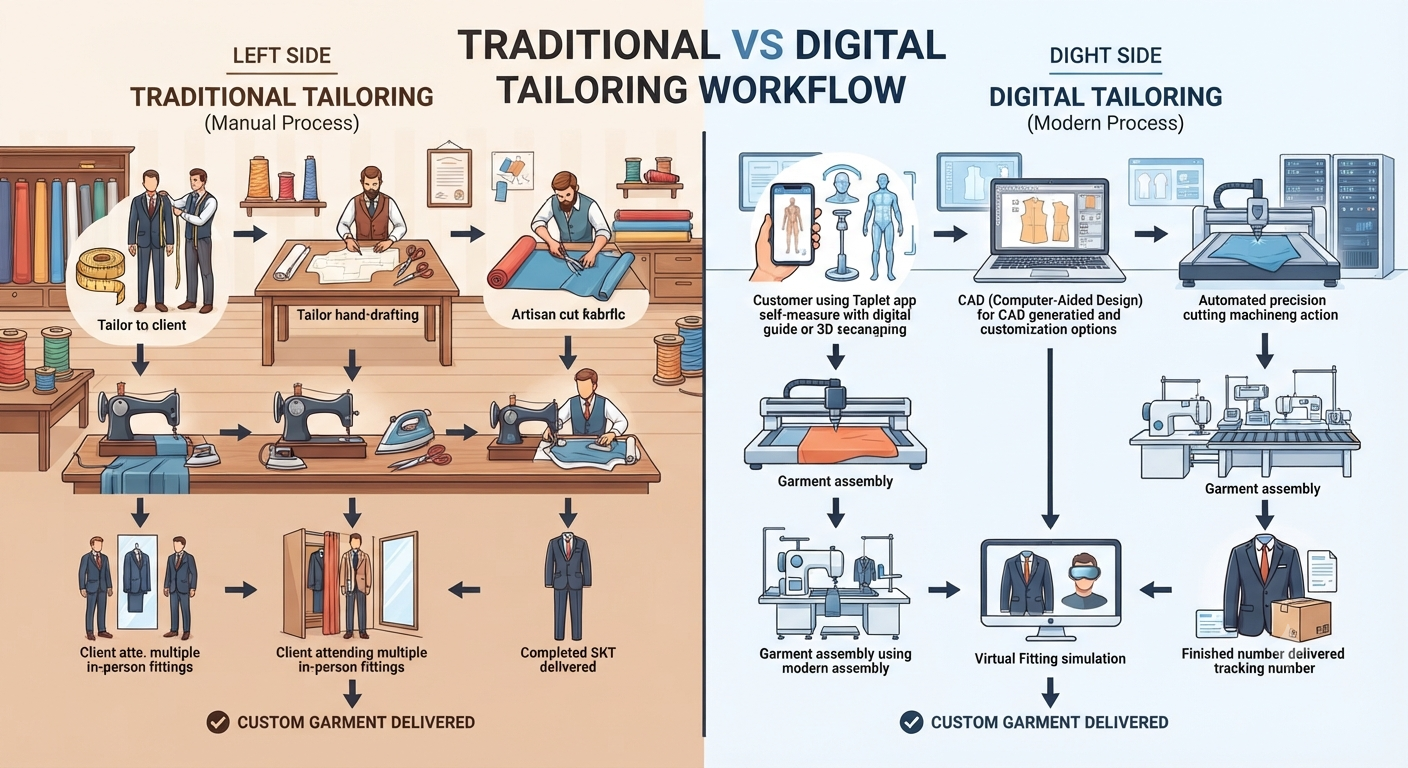
The five stages above happen in every tailoring shop. The table below shows the same five stages, comparing how each one is typically handled with paper and memory against how it works in a digital tailoring business.
| Stage | Traditional shop | Digital tailoring business |
|---|---|---|
| Enquiry | ✗ Written on a slip or remembered | ✓ Logged against a searchable customer profile |
| Measurements | ✗ Often re-taken on repeat visits | ✓ Saved once, reused for future orders |
| Order status | ✗ Tracked in the tailor’s memory | ✓ Updated and visible to anyone in the shop |
| Payments | ✗ Noted in a separate cash diary | ✓ Advance and balance tracked per order |
| Backup | ✗ One physical copy, one location | ✓ Cloud backup, accessible from any phone |
Why the Customer Profile Is the Center of Everything
The single most important idea in a digital tailoring business is this: every piece of information is connected to one customer profile, rather than scattered across separate books, chats, and slips.
In a paper-based shop, a returning customer’s history is split apart by design. Her measurements are in one register. Her last order is on a slip that may or may not still exist. Her advance payment is a line in a cash diary. Piecing her story back together takes time, and it depends entirely on you remembering where each piece was written down.
In a digital tailoring business, all of that sits under one profile. Search her name or phone number once, and everything appears: every garment she has ordered, every measurement set, every payment, and every delivery date. The customer profile becomes the shop’s memory, and unlike a human memory, it does not fade, get distracted, or forget.
How Measurements Work Differently in a Digital Shop
Measurements deserve their own explanation, because this is where a digital tailoring business differs most from a simple digital notebook.
- Measurements are organised by garment, not just by customer. A single customer can have a blouse measurement set, a separate salwar set, and a separate lehenga set, all under her one profile.
- A measurement is entered once and reused. When she orders another blouse a year later, the tailor does not start from zero; the previous measurements are right there to confirm or adjust.
- Notes travel with the measurement. A design preference, a fit adjustment from a previous alteration, or a reference photo can sit alongside the numbers, so nothing depends on memory.
This is different from a general note-taking app or a spreadsheet, which has no built-in understanding of what a “blouse measurement” or a “kurta measurement” actually consists of. A digital tailoring business uses software structured specifically around garment types and tailoring terms, which is what makes the record useful at the counter, not just tidy on a screen.
How Orders and Payments Move Through the System
An order in a digital tailoring business is not a single note; it is a small record that grows as the order progresses.
Order created
Garment type, fabric, design notes, and promised delivery date are recorded against the customer profile.
Advance logged
Whatever amount the customer pays upfront is recorded immediately, tied to that specific order.
Status updated
As the garment moves through cutting and stitching, the order’s status can be updated so it is clear what stage it is at.
Balance and invoice
At delivery, the remaining balance is collected, matched against the advance, and an invoice is created for the customer.
Because the advance is recorded the moment it is paid, there is no dispute later about how much a customer has already paid. Because the delivery date is attached to the order rather than a loose slip, nothing depends on remembering which garment was promised for which day.
Where the Data Actually Lives
A fair question at this point is: if everything is digital, what happens if the phone is lost, dropped, or damaged? This is where cloud backup matters. In a well-built digital tailoring business, the phone is simply the window into the data, not the only place it exists.
The actual records, customer profiles, measurements, orders, and payments, are stored securely online, synced from the phone. If a phone is lost or replaced, signing in on a new one restores everything. This is the opposite of a paper register, where the notebook itself is the only copy, and losing it means losing the information permanently.
A Day in a Digital Tailoring Shop
To make this concrete, here is what a normal working day looks like once a shop has made the switch.
Morning: A regular customer calls to confirm her lehenga blouse will be ready by Friday. The tailor searches her name, sees the order was logged three days ago with a delivery date of Friday, and confirms it in seconds, without checking a slip or a diary.
Afternoon: A new customer walks in for a first fitting. Her name, phone number, and blouse measurements are entered directly into her new profile while she is standing at the counter. The whole process takes a few minutes.
Evening: A customer arrives to collect a finished kurta. The tailor opens her profile, sees the advance she paid two weeks earlier, calculates the balance instantly, and generates an invoice, all without opening a separate cash book.
None of this requires the tailor to be especially tech-savvy. Each of these actions is a normal, everyday task, just carried out through an app instead of a pen.
Who Runs a Digital Tailoring Business Today
Digital tailoring businesses in India today are not large factories or fashion houses alone. They are ordinary neighbourhood tailors and boutique owners who have simply moved their record-keeping from paper to a phone.
- Neighbourhood tailors with 50 to 300 repeat customers who need fast, reliable retrieval of old measurements.
- Boutique owners managing several garment types for the same clients, each requiring separate measurement sets.
- Fashion designers with a smaller but high-value client base, where every detail of a client’s history matters.
- Multi-worker shops, where more than one person needs access to the same customer and order information.
How TailorFit Runs This Process
TailorFit is built specifically to run the five-stage process described above, for Indian tailors, boutiques, and fashion designers, entirely on an Android phone. It covers:
- Customer profiles holding name, phone number, and full order history.
- Garment-wise measurement storage for blouses, kurtas, salwars, sherwanis, lehengas, and more.
- Order records with fabric, design notes, and delivery dates.
- Advance and balance tracking tied to each individual order.
- Instant search by name or mobile number.
- Secure cloud backup, so data survives a lost or replaced phone.
A tailor can add a new customer and take their first order in under three minutes, at the counter, while the customer waits. When that same customer returns eight months later asking for “the same fitting as last time”, the full answer is one search away.
Run Your Shop the Digital Way, Starting Today
TailorFit connects every customer, measurement, order, and payment in one Android app built for Indian tailors and boutiques.
Download TailorFit on Google Play Android · Made for Indian tailoring shops · No computer neededFrequently Asked Questions
How does a digital tailoring business actually work?
A digital tailoring business runs the same tailoring process as before, but records every stage, enquiry, measurements, order, advance payment, and delivery, under one searchable customer profile on an app, instead of across separate paper registers, chats, and diaries.
Does going digital change how the stitching is done?
No. The craft, fittings, and stitching stay exactly the same. What changes is how customer information, measurements, and order details are recorded, stored, and found again later.
What happens to old measurements when a shop goes digital?
Most shops move gradually. New customers are recorded digitally from day one, and older customers’ measurements are copied into the app the next time they visit, rather than typing out an entire old register at once.
Is a digital tailoring business only for large boutiques?
No. Neighbourhood tailors with even 50 to 100 repeat customers benefit as much as large boutiques, since the core problem, finding old records quickly and tracking payments accurately, applies at any size.
What if the phone used for the app is lost?
With cloud backup, the actual data is stored securely online, not only on the phone. Signing in on a replacement phone restores customer profiles, measurements, orders, and payment records.
Is TailorFit an example of a digital tailoring business tool?
Yes. TailorFit is built specifically to run the enquiry-to-invoice process described in this article, for Indian tailors, boutiques, and fashion designers, entirely on an Android phone with cloud backup.
Leave a Reply