One Client. Three Garments. Zero Confusion.
The smarter way boutique designers handle garment-specific measurement records without paper chaos.
How Fashion Designers Can Organize Client Measurements for Every Garment Type
Picture this: it is the peak of wedding season, and your boutique has 32 active clients. Priya Sharma needs a blouse, a lehenga, and a kurta. Neha Bhatia has ordered a gown and a sherwani for her husband. Ritu Mehta is somewhere in a pile of yellow sticky notes with measurements scrawled in three different handwriting styles.
You call your tailor to start cutting Priya’s blouse. He asks for her measurements. You flip through your notebook, find a page labeled “Priya,” and read out the numbers. The blouse comes back two inches too loose at the chest. That is because the measurements on that page were for her lehenga, which has a different choli fitting altogether.
This is not carelessness. This is a structural problem with how boutiques manage measurement records. And it is exactly the problem that a dedicated tailor app for fashion designers is built to solve.

Why Managing Client Measurements Gets Complicated for Designers
Fashion designers working across multiple garment categories deal with a measurement problem that most business tools were never designed to solve. The real issue is not the volume of clients. It is the fact that each client generates multiple, non-interchangeable measurement sets based on the garments they order.
Here is how most boutiques currently manage this:
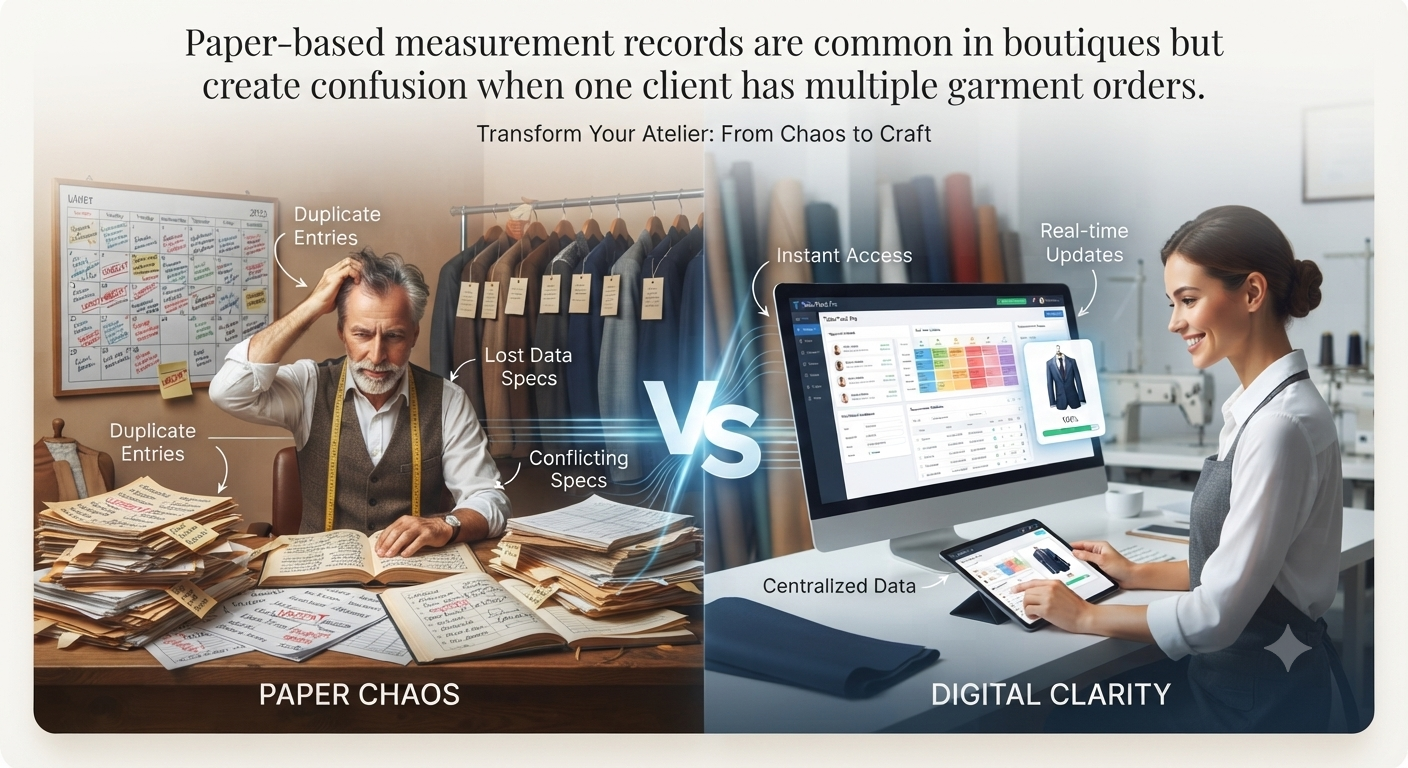
- Paper notebooks: Measurements are written sequentially. One page per client. Blouse measurements sit right above lehenga measurements with no visual separation. A busy tailor reads the wrong row under pressure and cuts accordingly.
- WhatsApp messages: Designers share measurements via chat, which scrolls out of reach within days. Finding a specific garment measurement means scrolling through hundreds of messages.
- Excel sheets: Better than notebooks, but not designed around garment workflows. Column headers like “chest” and “waist” appear once, and tailors assume those values apply to every garment for that client.
- Loose slips and receipts: These get misplaced, water-damaged, or accidentally thrown away. Retrieving them during production is the single biggest cause of repeated measurement sessions.
None of these methods connect a measurement to its specific garment. That connection is the entire problem.
Why Each Garment Needs a Separate Measurement Set
This is something customers do not always understand, but designers know it immediately. A blouse and a lehenga choli look similar from the outside, but they require completely different fitting parameters.
| Garment | Key Measurements Required | Critical Fit Points |
|---|---|---|
| Blouse | Bust, waist, shoulder width, sleeve length, back length, armhole depth | Armhole depth and back closure position |
| Lehenga | Waist, hip, skirt length, choli measurements | Hip flare and waistband fall |
| Kurta | Chest, waist, shoulder, sleeve, kurta length, neck width | Length and shoulder seam alignment |
| Gown | Full-body measurements from bust to hem, train length, sleeve type | Bodice structure and hem grade |
| Sherwani | Chest, waist, shoulder, sleeve, collar height, sherwani length | Collar fit and body silhouette |
When a tailor applies lehenga-hip measurements to a blouse armhole calculation, the garment will not fit. When a kurta-length reference is mistaken for a gown-hem measurement, the fabric is cut short and the order has to be redone from scratch. These are not hypothetical errors. They happen in boutiques every week.
Common Measurement Management Problems in Boutique Businesses
- Lost measurement sheets during busy production periods, requiring clients to come back for remeasurement
- Repeated measurements across orders because the original record cannot be located quickly
- Confusion during stitching when multiple tailors work on different garments for the same client
- Production delays caused by waiting for clarification on which measurement value applies to which garment
- Client dissatisfaction when repeat customers expect their stored measurements to be on hand but they are not accessible
- Version errors when a client’s measurements are updated for a new order but the old value is still referenced for a pending order

What Is a Tailor App for Fashion Designers
A purpose-built tailor app goes beyond basic contact storage. It is a measurement management system designed around how boutique workflows actually operate. Each client gets a profile. Each order within that profile is tied to a garment type. Each garment type carries only the measurement fields that apply to it, pre-structured as a template.
When your tailor needs Priya’s blouse measurements at 8 PM during a deadline rush, they open the app, type her name, and the blouse measurement card is right there. Lehenga measurements are in a separate card below it. There is no chance of cross-referencing the wrong values because they are visually and structurally separated from the first tap.
How Digital Measurement Management Works in Practice
The logic is simple once you see it in action. Here is what a well-structured digital measurement system handles:
Customer Profiles
Each client has a single, searchable profile. Their contact information, order history, and all associated measurements live in one place. You never create duplicate entries for the same person. When they return next season, their past measurements are already there for reference.
Garment-Specific Measurement Templates
Instead of a blank page, the app gives you a pre-built template for each garment type. A blouse template asks for armhole depth. A kurta template asks for kurta length. A sherwani template includes collar height. You only fill in what matters for that garment, which means there are no irrelevant fields cluttering the view when your tailor reads it.
Multiple Garment Records Under One Client
A single client profile can hold as many garment measurement cards as needed. Priya’s profile has a blouse card, a lehenga card, and a kurta card. They are clearly labeled and completely independent of each other. Adding a fourth garment next month is a matter of opening her profile and creating a new card.
Searchable, Accessible Records
During production, your tailor can search a client name and pull up exactly the measurement set they need in under ten seconds. No flipping through pages. No calling you at an inconvenient hour. The information is available to anyone on your team with app access, from anywhere.
How TailorFit Helps Designers Organize Client Measurements
TailorFit is built specifically for this workflow. It is a tailor management app that treats garment-type measurement organization as a core feature rather than an afterthought.
Here is what the platform gives you as a designer managing a multi-garment boutique:
- Pre-built measurement templates for blouses, lehengas, kurtas, gowns, sherwanis, and other Indian and Western garment types
- Individual client profiles that store full order history alongside measurement cards
- Garment-wise measurement storage so each order carries its own independent measurement set
- Quick search and retrieval by client name during any stage of production
- Measurement access during order creation, pulling saved profiles directly into new orders without re-entry
- Cloud storage so your records are never lost to a torn notebook or a broken phone
This is what a genuine digital tailoring software looks like when it is designed for real boutique operations rather than generic business management.
Example Boutique Workflow Using TailorFit
Client Profile: Priya Sharma
That is the practical difference between paper records and a purpose-built tailor measurement management system. The data is the same. The organization is completely different.
Benefits for Designers Managing Many Clients
Garment-specific templates prevent cross-referencing errors at the cutting stage, which is the most expensive point to fix them.
Repeat clients do not need to come in for remeasurement. Their records are already organized and ready to attach to a new order.
Your tailors can access the right measurements independently, without interrupting your client consultations or phone calls.
Boutiques that remember a client’s measurements from three seasons ago feel premium. That recall builds trust and repeat business.
A digital system that handles 30 clients with the same ease as 300 lets your boutique grow without adding administrative overhead.
Cloud-backed measurement profiles survive floods, broken phones, and staff turnover. Your data is always accessible.
Why Boutiques Are Moving to Digital Measurement Tools
The shift is already happening across Indian boutiques and fashion design studios. Designers who manage seasonal order spikes during Navratri, Diwali, and wedding season are the ones pushing hardest toward digital systems because paper simply breaks at scale.
There are a few clear patterns driving this transition:
Customer expectations have changed. Clients who interact with digital-first businesses everywhere now expect their boutique to have their measurements on file. Asking a repeat customer to stand for remeasurement because the notebook was lost reads as unprofessional, not just inconvenient.
Production teams are larger than they used to be. A solo tailor can hold a few client details in memory. A five-person stitching team working across 40 active orders needs a shared, reliable data source. Paper cannot serve that function.
Fitting errors are expensive. Recutting fabric, calling clients back, delaying deliveries during a competitive season: these costs compound fast. A tailoring business management app that eliminates even two fitting mistakes per month pays for itself quickly.
Measurement data has long-term value. When a client comes back in two years for another occasion outfit, having their accurate measurements from the previous order means you can start production faster, often without an in-person measurement session. That is a genuine competitive advantage for boutiques building long-term client relationships.
Wrapping Up
The core problem is straightforward: one client places multiple garment orders, each requiring a different, non-interchangeable measurement set. Paper records, WhatsApp threads, and Excel sheets are not structured to keep those sets visually and functionally separated. That gap leads to production errors, fitting failures, and time wasted in a season when time is the scarcest resource you have.
The solution is equally direct. A dedicated tailor app for fashion designers that organizes measurements by garment type under individual client profiles turns a chaotic notebook problem into a clean, searchable system. Your tailor pulls up a name and sees exactly what they need, for exactly the garment they are working on.
TailorFit is built for this. If your boutique handles more than a handful of active clients at any point during the year, this is the kind of structural change that makes a real difference to how your production floor runs. You can explore TailorFit and see how it handles garment-specific measurement management in practice.
Ready to Organize Your Client Measurements by Garment?
TailorFit gives your boutique the measurement management structure it needs. One client, multiple garments, zero confusion.
Try TailorFit
Leave a Reply