From Paper Slips to One Dashboard: A Tailor’s Complete Guide to Digital Order Tracking
Picture this: It is a busy Monday morning. Your shop has 60 active orders running at the same time. A customer calls to ask if her salwar suit is ready. You flip through a register, squint at smudged handwriting, and realize you cannot tell if it is in cutting, stitching, or already done. You call back with a vague answer. She does not come back.
This is not a rare situation. Thousands of tailors and boutique owners across India face it every day. The problem is not the skill of the tailor. The problem is the system, or the lack of one. Managing orders on paper in 2026 is like threading a needle in the dark: possible, but needlessly painful.
This guide explains exactly how tailors can track orders digitally, the difference it makes for delivery accuracy and customer trust, and how a tool like TailorFit makes the switch straightforward, even for tailors who have never used an app for business before.
To track tailor orders digitally, create a customer profile in a tailoring management app, save measurements, link each order to the customer, and update the order status as it moves from Received to Cutting to Stitching to Delivered. Apps like TailorFit do all of this from an Android phone with no computer or technical knowledge needed.
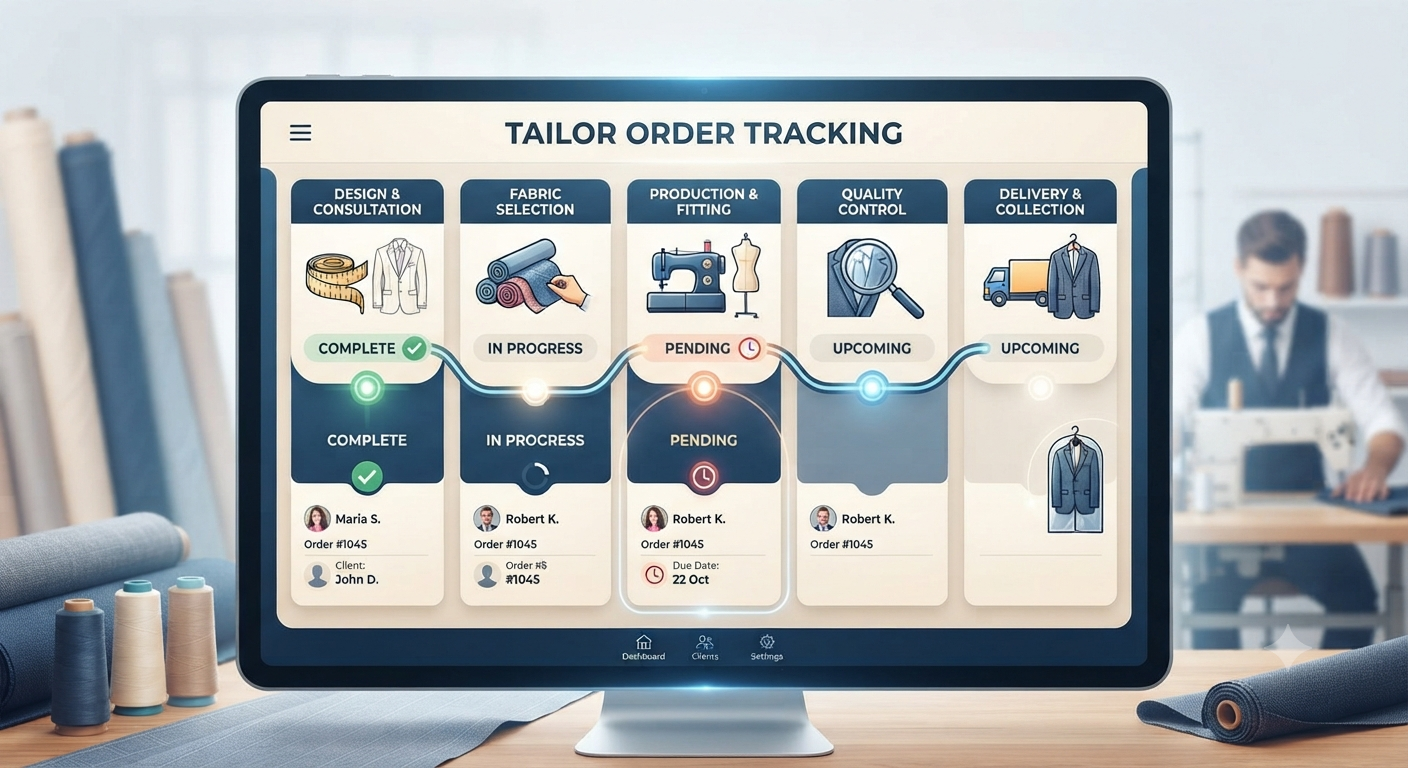
Why Paper Order Tracking Fails Tailors
Paper registers and measurement notebooks served tailors for generations. But the demands of a modern tailoring business, including more customers, faster turnarounds, tight delivery windows, and repeat orders, have outgrown what paper can handle. Here is where the system breaks down.
Manual vs Digital Tailoring Workflow: A Clear Comparison
The difference between a manual and digital tailoring workflow is not just about technology. It is about how much control you have over your business at any given moment.
| Workflow Step | Paper System | Digital System (TailorFit) |
|---|---|---|
| Taking Measurements | Written in a register. Prone to fading, tearing, or being misread. | Stored digitally with templates. Retrieved in seconds by name or number. |
| Creating an Order | Loose slip or notebook entry. Easy to misplace under a pile of fabric. | Linked to customer profile. Cannot be lost. Accessible from any device. |
| Tracking Status | No visibility. Tailor must physically check each order’s location in the shop. | Live status: Received, Cutting, Stitching, Ready, Delivered. Visible at a glance. |
| Delivery Date Reminders | Relying on memory. Delays happen silently until the customer calls. | Due dates are visible on the dashboard. Overdue orders flagged automatically. |
| Payment Tracking | Recorded in a separate register. Balance amounts often get missed on delivery. | Advance and balance recorded per order. Dues clearly shown before delivery. |
| Repeat Orders | Measurements re-taken. Customer waits again. Time wasted on both sides. | Old measurements retrieved instantly. Repeat orders take minutes to create. |
| High-Volume Order Rush | Chaos. No prioritization. Deliveries missed. Customers frustrated. | Filter by due date. Prioritize urgent orders. Work in a controlled, structured queue. |
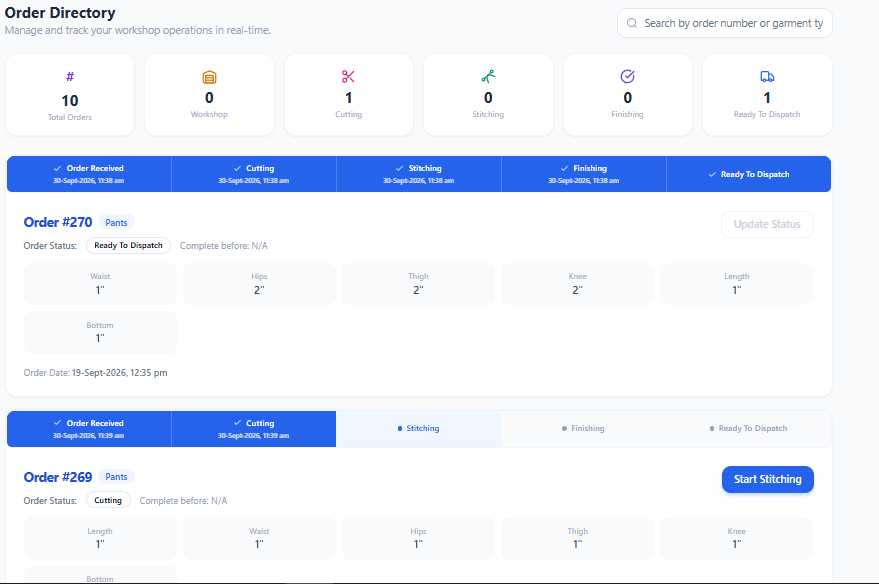
What Is Digital Order Tracking for Tailors?
Digital order tracking for tailors is a system in which every customer order, including measurements, garment specifications, due dates, payment details, and status updates, is stored in a secure cloud-based application instead of paper registers or notebooks.
A tailoring order tracking system gives a tailor or boutique owner real-time visibility into every active order: what stage each garment is at, which orders are due soon, which are overdue, and what payment is outstanding. This visibility is the single most important thing missing from paper-based tailoring businesses.
Key Elements of a Digital Tailoring Workflow
A complete digital tailoring workflow covers five core areas that together replace everything currently managed on paper:
How to Track Tailor Orders Digitally: Step by Step
Setting up digital order tracking does not require a computer, a data entry operator, or weeks of onboarding. Here is how a tailor can do it using a mobile app.
-
Create the Customer ProfileAdd the customer’s name and phone number. You can also add a photo, address, and any notes about their stitching preferences. This profile stays in the system permanently and is reused for every future order from the same customer.
-
Record Measurements DigitallyUse the app’s measurement templates for men, women, or children. Enter each body measurement and save it to the customer’s profile. Add stitching instructions and fitting notes in the same place. No separate notebook needed.
-
Create the OrderLink the order to the customer’s profile. Add the garment type, fabric details or reference image, agreed price, advance received, and the promised delivery date. All of this is stored under one order entry.
-
Update Status as Work ProgressesAs the garment moves through your workflow, update the order status. This gives you and your team live visibility into which orders are at which stage, without asking anyone verbally.
-
Deliver and Close the OrderExport a measurement report or invoice as a PDF. Share it with the customer on WhatsApp for a professional delivery experience. Record the final payment, mark the order as Delivered, and the record stays in your history permanently.
measurements saved
to pattern
being stitched
awaiting pickup
payment cleared
What Measurements Should a Tailor Store Digitally?
A well-organized digital measurement record includes more than just the basic chest and waist numbers. The more complete the record, the fewer alterations are needed and the faster repeat orders can be processed.
TailorFit supports predefined templates for Men, Women, and Kids with all standard garment measurement fields plus custom notes.
Why Storing 30+ Measurements Matters for Your Business
A tailor who stores complete measurements does not have to ask a customer to visit the shop again for a repeat order. The customer sends a WhatsApp message, the tailor opens the app, pulls up the profile, creates the order in two minutes, and confirms. This kind of service keeps customers coming back year after year.
According to industry research on tailoring CRM systems, boutiques that maintain complete digital customer profiles report significantly higher repeat order rates compared to shops relying on manual registers. The operational efficiency gained from instant measurement retrieval is one of the clearest competitive advantages a tailor can build today.
How TailorFit Solves the Order Tracking Problem
TailorFit is a digital measurement and order management app built specifically for Indian tailors, boutique owners, and fashion designers. It is designed around the real workflow of a tailoring shop, not a generic business management system adapted for tailors.
The core idea behind TailorFit is simple: replace the paper measurement book with a secure, searchable, cloud-backed digital system that works from an Android phone. Here is what it covers in practice.
TailorFit is built keeping Indian tailoring workflows in mind. Many tailors across India are not comfortable with English or complex tech interfaces. TailorFit addresses this with a simple, clean interface designed for daily tailoring routines, whether you run a gents tailoring shop, a ladies boutique, a designer studio, or a uniform stitching unit.
Digital Order Tracking for Boutiques vs Independent Tailors
The need for digital order tracking looks different depending on the size and type of the tailoring business. Here is how it applies across two common setups.
For Independent Tailors and Small Shops
An independent tailor typically handles 10 to 40 active orders at a time. The biggest challenge is not volume; it is visibility during busy months when that number suddenly doubles. A mobile app like TailorFit lets a solo tailor see all active orders on one screen, know exactly which ones are due this week, and retrieve any customer’s measurements without interrupting their stitching work.
For Boutiques and Multi-Tailor Shops
A boutique managing 80 to 200 simultaneous orders needs more than a notebook. It needs a boutique management system that can assign work, track each garment across multiple stages, manage customer communication, and generate reports on pending deliveries. Digital order tracking is not optional at this scale; it is the operational foundation.
TailorFit supports unlimited customer profiles, making it suitable for growing boutiques that handle a high volume of repeat and new customers across multiple garment types.
What to Look for in a Tailor Order Tracking App
Not every tailoring app is built equally. Many generic business management tools exist, but they are not designed around the specific needs of a tailoring workflow. When evaluating a tailor order management app, look for these features.
Must-Have Features
The app should offer digital measurement storage with garment-specific templates, customer order creation with due dates and payment tracking, live order status updates, PDF export for WhatsApp sharing, and secure cloud backup. Without all five, gaps will still exist in your workflow.
India-Specific Considerations
An app built for Indian tailors should support Indian garment types (salwar kameez, saree blouse, kurta, sherwani, lehenga, and more), work reliably on budget Android phones, function without constant internet access, and be simple enough for a tailor with no prior app experience to use from day one.
Data Security
Customer measurement data is sensitive business data. The app must offer encrypted cloud backup so that no data is lost if a device is damaged, lost, or changed. Verify that the app stores data on the user’s account and not only on the device.
TailorFit checks all of these requirements. You can explore all features at tailorfit.app/features.
Frequently Asked Questions
Answers to the most common questions from tailors, boutique owners, and fashion designers in India about digital order tracking.
How do I track tailor orders without a computer?
What is the best app to manage tailoring orders in India?
How do boutiques manage multiple orders at the same time?
Can a tailor app reduce delivery delays?
How does digital order tracking help when order volume increases suddenly?
Is TailorFit free to use?
What happens to my customer data if I lose my phone?
Can I share order details and measurements with customers on WhatsApp?
The Bottom Line for Tailors in India
The tailoring business in India is not short of skilled craftspeople. What separates a shop that grows from one that stays stuck is the system behind the craft. A tailor who tracks orders digitally delivers on time more consistently, makes fewer measurement errors, handles repeat customers faster, and builds a level of trust that paper-based competitors cannot match.
Switching to digital does not require a large investment, a computer, or a technical background. It requires downloading an app, adding your first few customers, and building a habit. Once the habit is in place, the benefits compound with every order.
TailorFit is designed to make that habit as easy as possible to build. Start for free at tailorfit.app and take your tailoring business from paper slips to a professional, organized system today.

Leave a Reply